🧠 Sound science — listening effort
“I understood every word” — and your brain still paid for it
The usual objection is simple: “I can still understand it, so what is the problem?” The research answer is just as simple. Even at 100% comprehension, the brain spends measurably more of itself filling in what compression removed — and that spending shows up as fatigue and weaker learning.
🧠Understanding it is not the same as it being free
Audio degraded by compression or lost bandwidth (in the literature: degraded speech) still gets decoded — but the brain has to fill in the gaps unconsciously. Researchers call the cost listening effort, and they have measured it three different ways.
📑What the studies measured
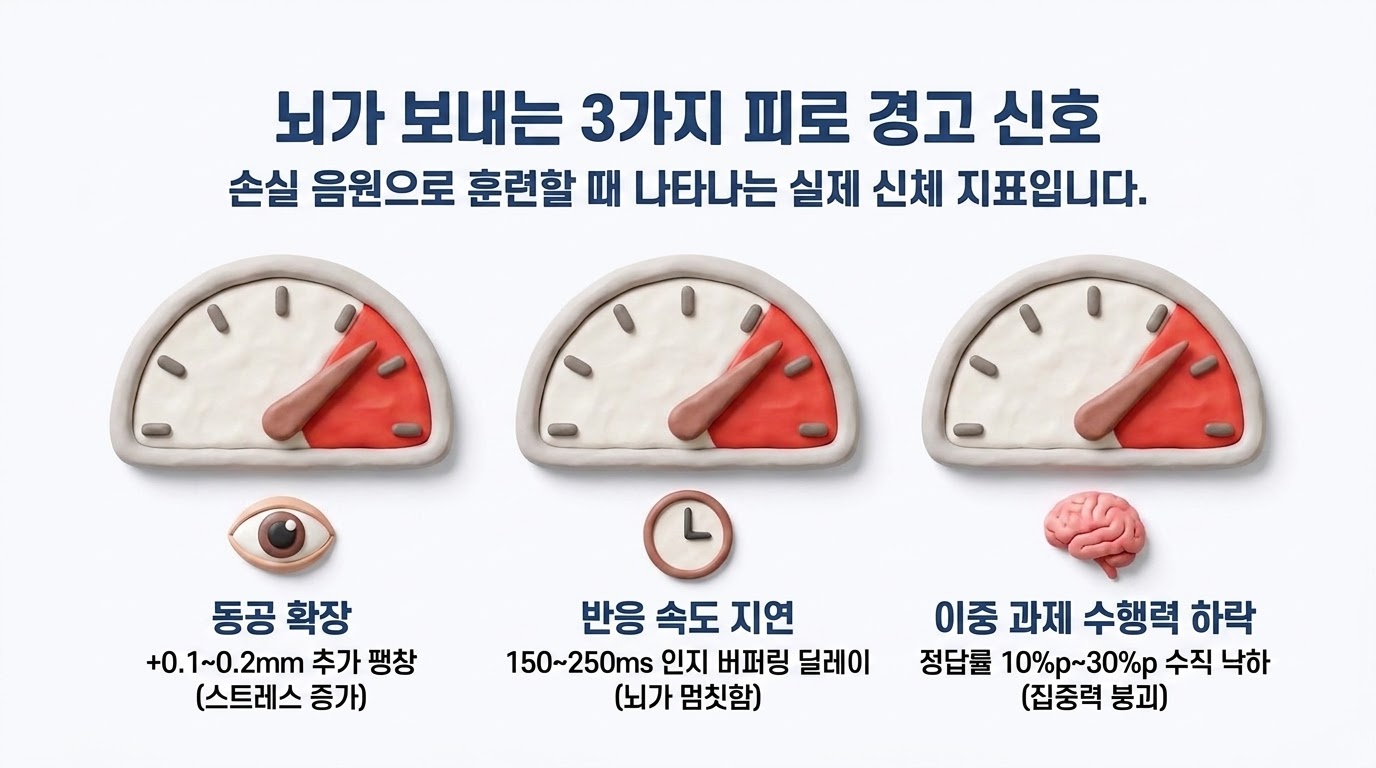
- Pupil +10–20%Peak pupil dilation grows by roughly that much with degraded audio — the most objective physiological read-out of how hard working memory is being squeezed. (Winn, Edwards & Litovsky, 2015 · Ear and Hearing)
- Spare capacity −10–30ppListeners still get the words right, but accuracy on a simultaneous memory task drops by that margin — capacity that should have gone to learning and recall. (Sarampalis et al., 2009 · JSLHR)
- Response +0.15–0.25 sThe time to decode sound into meaning and respond stretches by that much — at high playback speeds every word becomes a bottleneck. (Pals et al., 2015 · JASA)
🔋 In plain terms — up to 30% of your study battery leaks
Picture attention as a battery at 100%. With lossless audio the whole charge can go into understanding and remembering. With lossy audio the brain quietly siphons power off to reconstruct broken sound, and up to 30% of the capacity you meant to spend on learning evaporates. Same hour of study, less left in your head.
🎧The faster you listen, the more this matters
Listening to familiar speech at normal speed leaves enough headroom to absorb the cost. But catching unfamiliar phonemes in a foreign language, or pushing playback speed to build comprehension quickly, is exactly where spare capacity decides success. Choosing lossless WAV or CD audio is not an audio-quality preference — it is how you keep limited cognitive resources pointed at learning.
Source
Key concepts: listening effort (Peelle) and cognitive spare capacity (Rudner). Measurement studies: Winn et al. (2015, Ear and Hearing), Sarampalis et al. (2009, JSLHR), Pals et al. (2015, JASA).
※ This article summarizes and restructures the key points of the source above.
👂 Hearing and the brain · 5 more on this
- 🧠 Hearing loss is the top dementia risk factor — the science of getting sound back
- 🔬 The cognitive cost of compressed audio, in three numbers
- 📡 Hearing age and audible frequency — what the top of your range says
- ⏱️ The 0.04 seconds that separates bad from dad
- 🏋️ Speed listening is not language practice — it is exercise for the brain