🔬 Sound science — the research figures
The cognitive cost of compressed audio, in three numbers
“I understand MP3 audio perfectly well, so what is the problem?” Consciously, that is true. But when researchers put physiological measures on it, the brain turned out to be working overtime the whole time. The term in the literature is listening effort with degraded speech — here it is in three numbers.
📊The three numbers
Every one of these gaps was measured in conditions where participants felt they had caught everything that was said.
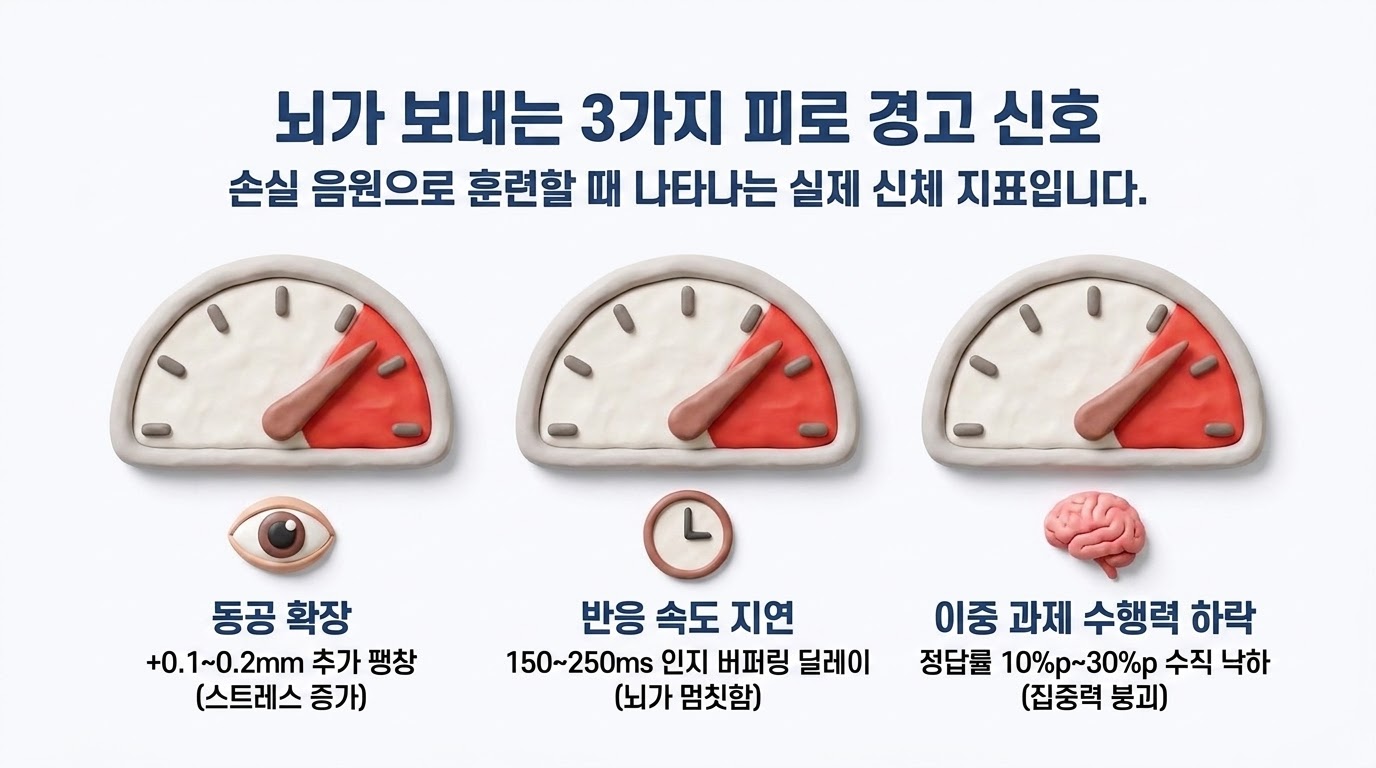
- Pupil +10–20%Peak pupil dilation grows by 0.1–0.2 mm when the audio is compressed or otherwise degraded. The pupil is the most sensitive autonomic read-out we have of how hard the brain is squeezing out computation — physical evidence that it is working overtime, filling in what was shaved off the sound. (Winn et al., Ear and Hearing, 2015)
- Memory −10–30ppA dual-task experiment: listen to words while solving a shape or digit task at the same time. With the original audio, accuracy on the secondary task holds at 85–90%; switch to compressed audio and it falls by 10–30 percentage points. Capacity that should have gone into remembering is spent restoring the sound instead. (Sarampalis et al., JSLHR, 2009)
- Response +0.15–0.25 sThe time it takes for sound to be decoded into meaning and come back out as a response stretches by 150–250 ms with degraded audio, and by as much as 800 ms in bad cases. On the timescale the brain computes at, that is an enormous bottleneck. (Pals et al., JASA, 2015)
🧠Why this happens — the brain fills in the blanks
MP3 and AAC use psychoacoustic models to shave off the bands and fine detail judged “hard to hear anyway”, which is how the file gets small. What follows is the problem: given an incomplete signal, the brain unconsciously restores the missing pieces in order to complete the auditory pattern. That extra computation eats into frontal working memory — this is listening effort — and the cognitive spare capacity left over for understanding the content and moving it into long-term memory shrinks with it (concepts developed in the work of Peelle, Rudner and others).
⚡ At speed the gap grows out of all proportion
In your own language at ordinary speed the brain has room to do the restoring. In training with the playback speed raised, 0.2 s of delay on every word makes you miss the next one — and you are training with 20–30% of your spare capacity already gone. Lossless audio is not an acoustic preference; it is the condition for pointing all of a limited energy budget at learning. It lines up exactly with what we saw in-house when Speed English moved to WAV and the training period halved.
🔬Training without burning the energy
If it is going to be thirty minutes either way, spend them on learning rather than on reconstruction.
Source
Winn, Edwards & Litovsky, Ear and Hearing (2015) · Sarampalis et al., JSLHR (2009) · Pals, Sarampalis, van Rijn & Başkent, JASA (2015) · concepts of listening effort (Peelle) and cognitive spare capacity (Rudner). An introduction to the topic is [[listening-effort]].
Read the original →※ This article summarizes and restructures the key points of the source above.
👂 Hearing and the brain · 5 more on this
- 🧠 Hearing loss is the top dementia risk factor — the science of getting sound back
- 📡 Hearing age and audible frequency — what the top of your range says
- ⏱️ The 0.04 seconds that separates bad from dad
- 🏋️ Speed listening is not language practice — it is exercise for the brain
- 🧠 “I understood every word” — and your brain still paid for it